How to protect your belongings while traveling
The primary difference between a minor travel annoyance and a catastrophic trip disaster is often the security of your belongings. Losing a passport, wallet, or critical electronics to theft can halt your journey and cause immense stress. While no security measure is foolproof, adopting a **proactive mindset and employing smart, multi-layered defenses** drastically reduces your risk, making you a less appealing target for thieves.
On the Street and In Transit: Personal Security 🛡️
The majority of small-scale theft, like pickpocketing and bag snatching, occurs in crowded, transitional areas.
1. Distribute and Disguise Your Valuables
The goal is to ensure that if one item is lost or stolen, your entire trip isn’t jeopardized:
- **The Separation Rule:** Never carry all your cash, all your credit cards, and your passport in the same place. Keep your main documents in a secure, hidden pouch (like a **money belt or neck wallet**), and only carry the cash and one debit/credit card you need for the day in your main wallet.
- **Low-Profile Gear:** Avoid looking like a wealthy tourist. Don’t wear flashy jewelry, and use bags that don’t scream “expensive camera inside.” Simple, slightly scuffed backpacks are often better than brand-new designer luggage.
- **The Front Carry:** In crowded areas (markets, subways), wear backpacks on your chest rather than your back. Keep shoulder bags and camera straps diagonally across your body and ensure the closure flap faces you, not the street.
2. Securing Bags in Transit
Thieves target luggage during distracted moments on buses, trains, and planes:
- **Lock Down:** Use **TSA-approved locks** on all checked and carry-on luggage. For trains and buses, use a small cable lock to secure your bag to the luggage rack or your seat support. This prevents a quick grab-and-run theft.
- **Stay Attached:** Never put your day bag or purse on the floor or on the back of a chair in a public place (café, restaurant). Keep it in your lap or loop a strap around your leg.
Solo Traveler’s Advice: Jen H., Security Travel Blog
“I call it the **’Decoy Wallet’** trick. I carry one cheap, old wallet with about $20 in local currency and an expired card or two. If I’m ever held up or pickpocketed aggressively, I hand over the decoy immediately. It often satisfies the thief and allows me to keep my real cash, main cards, and identification safely hidden.”
In Accommodation: Hostels and Hotels 🏠
Even secure-looking rooms require vigilance, especially in shared spaces.
1. Mastering the Hostel Locker
Hostel lockers are your primary safe zone, but you must use them correctly:
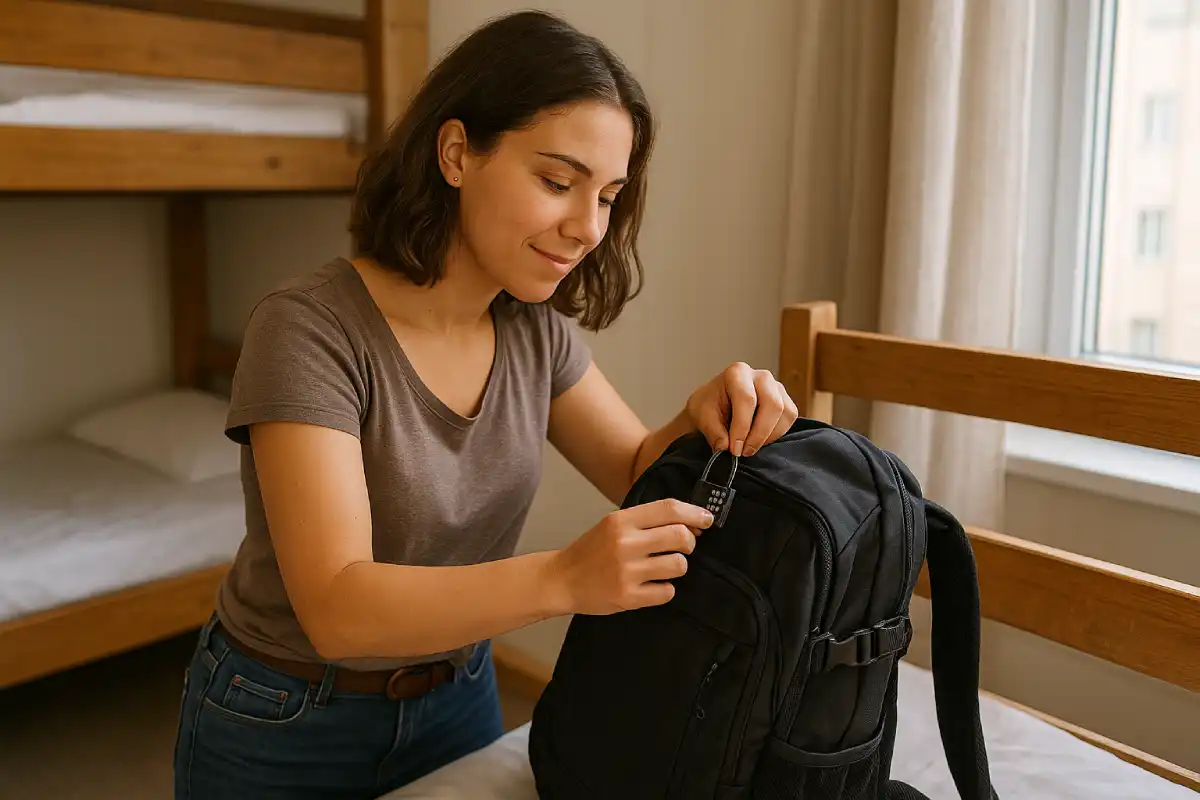
- **Bring Your Own Lock:** While hostels often provide lockers, they don’t always provide locks. Carry two high-quality **padlocks or combination locks** (one for the main backpack, one for the locker).
- **Lock Everything:** Laptops, cameras, cash, and passports must go into the locker whenever you leave the room, even for a five-minute shower. Don’t leave things charging unattended.
- **Creative Securing:** If the locker is too small for your main backpack, use your cable lock to secure the main zipper of your bag and then loop the cable through the bed frame or a secure luggage rack.
2. Hotel Room Precautions
Hotels are generally safer, but staff or external access are still risks:
- **Use the Safe:** Always use the in-room safe for cash, passports, and backup cards. When setting the code, choose a non-obvious number (not your birth year).
- **Unplug and Hide:** Never leave electronics (like phones or cameras) charging on a nightstand if cleaning staff or maintenance will be in the room. Unplug them and lock them away.
- **Door Stop:** For added peace of mind, carry a simple **rubber door stop** and wedge it under the door when you are sleeping or showering, making forced entry harder.
Tech-Savvy Traveler’s Essential: Alex C., Digital Security Journal
“Before I leave home, I turn on the **’Find My Device’** feature (for Apple or Android) on my phone and laptop. I also take a quick photo of my passport, visas, driver’s license, and all credit cards (front and back) and store them in an encrypted, cloud-based folder. If my bag is stolen, I have immediate access to my identity documents for reporting and replacement.”
Frequently Asked Questions About Protecting Belongings
What is the most secure way to carry my passport while walking around?
The most secure method is using a **money belt or neck wallet** worn under your clothing. If you must carry it in a bag, use a dedicated, hidden interior pocket that is difficult to access quickly. Never put your passport in a back pocket or an easily accessible backpack pocket.
Is travel insurance worth it just for covering lost items?
Yes. Travel insurance is essential for covering emergency medical costs, but it also provides a crucial safety net for loss or theft. Policies typically cover lost luggage, stolen items (up to a limit, often requiring a police report), and can help with costs associated with replacing essential documents. Read the fine print on coverage limits for high-value items.
Are anti-theft bags (slash-proof) really necessary?
They are not strictly necessary, but they provide an excellent deterrent, especially in areas known for bag slashings. They work because they make the thief’s job harder, often causing them to move on to an easier target. Prioritize bags with **lockable zippers** and **cut-resistant straps** for high-risk situations.
What should I do immediately after realizing something is stolen?
First, **file a police report** immediately; this documentation is required for insurance claims. Second, **call your bank/credit card companies** to cancel any stolen cards. Third, contact your embassy or consulate if your passport is missing. Use your pre-stored digital copies to streamline the reporting and replacement process.
How can I protect my laptop or camera in a small, shared accommodation?
If a locker isn’t available, secure your gear by locking it inside your main, heavy bag and then **cable-locking the bag to a fixed object** (like a radiator, heavy pipe, or bed frame). If you are leaving the room for an extended time, consider utilizing the hostel’s secure safe at the front desk for high-value items.
Conclusion: Security Is a Mindset
The best security device is not a lock or a reinforced bag; it is your **awareness**. By anticipating potential theft scenarios, distributing your most critical assets, and employing simple physical security steps, you significantly stack the odds in your favor. Be prepared, be vigilant, and remember that when you prioritize the security of your belongings, you create the freedom to focus entirely on the joy of travel.