How to Pack Light for Winter and Art of Warmth Without Bulk
Packing for a winter trip is notoriously difficult. Heavy coats, thick sweaters, and chunky boots quickly consume luggage space and often push bags over restrictive airline weight limits. However, the secret to packing light for cold weather lies not in bringing less clothing, but in bringing **smarter clothing** focusing on highly efficient, packable materials and mastering the **layering system**.
The Three-Layer System: The Minimalist’s Blueprint
The best way to stay warm is through three distinct, interchangeable layers. This system is crucial because trapped air between layers provides better insulation than one single thick garment.
1. Base Layer (Wick and Breathe)
This layer sits against your skin. It should wick moisture away to keep you dry, which prevents chilling.
- **Material Focus:** **Merino wool** or synthetic blends (polypropylene). Avoid cotton, which retains moisture and makes you cold.
- **Packing Tip:** Bring only two sets of thermal tops and bottoms. Merino wool is naturally odor-resistant and can be worn for several days before needing a wash.
2. Mid-Layer (Insulate and Warm)
This is your primary source of heat, trapping air close to your body.
- **Material Focus:** **Fleece** or thin, packable **down/synthetic puff jackets**. Down offers the best warmth-to-weight ratio and compresses incredibly well.
- **Traveler Advice:** “My single biggest space saver was switching to a high-quality compressible down jacket. It provides more warmth than three sweaters and packs down to the size of a water bottle. Wear it on the plane to save even more space.” (Source: Adventure Travel Magazine)
3. Shell Layer (Protect and Block)
This outer layer protects you from wind, rain, and snow.
- **Material Focus:** Waterproof and windproof shell (Gore-Tex or similar). This layer should be worn or carried, not packed, as it is the bulkiest item.
Strategic Packing Hacks and Material Choices 🎒
1. The Boot-First Strategy
Boots are often the bulkiest item. Wear your heaviest, largest boots on the plane. Pack light, collapsible secondary shoes (like thin sneakers) inside your bag. Use the space **inside** your packed boots for small, dense items like socks, chargers, or toiletries.
2. Compression Tools
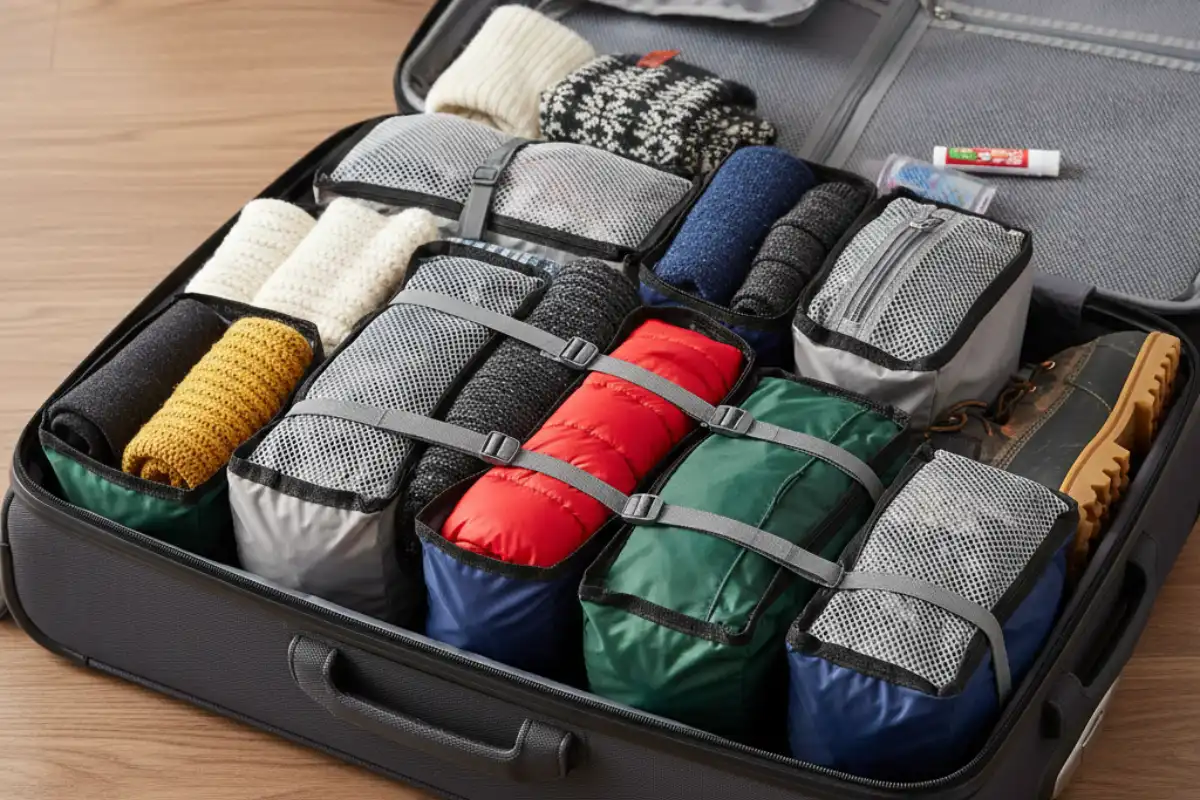
While vacuum bags are not practical (since you need to re-vacuum them), **compression packing cubes** are a minimalist’s best friend. They squeeze air out of bulky fleece and sweaters, saving up to 50% of the space they would normally take up.
- **Compression Tip:** “Use one small compression cube exclusively for hats, scarves, and gloves. These small items fill up pockets and voids, but when compressed together, they free up a shocking amount of space.” (Source: Minimalist Traveler Blog)
3. The ‘Two Is One’ Rule for Accessories
Minimize accessories by choosing items that serve multiple functions and match all your outfits (e.g., a neutral-colored wool hat and a single thick, warm scarf).
- **Socks:** Prioritize Merino wool socks. They are thin enough to pack easily, incredibly warm, and, like the base layer, you only need 2-3 pairs for a week-long trip due to their durability and odor-resistance.
Frequently Asked Questions About Packing Light for Winter
Is rolling or folding better for winter clothes?
For bulky items like sweaters and fleece, **folding** combined with compression cubes is generally more effective at managing bulk. For base layers and thin items, **rolling** saves space and minimizes wrinkles.
Can I really get away with only one coat?
Yes. The **shell layer** (windproof/waterproof jacket) is essential. If you combine that with a quality, thin **mid-layer** (like a compressible down jacket), you achieve the necessary warmth and weather protection without needing multiple heavy outer coats. Wear the bulkiest one while traveling.
What about toiletries and liquids in the cold?
Standard liquid rules apply for carry-on (3-1-1 rule). In freezing weather, ensure liquids (especially contact lens solution or face creams) are sealed well, as the cold can sometimes cause bottles to contract and leak. Keep essential creams in an inner pocket to prevent them from freezing solid.
Are heated clothing batteries allowed in carry-on?
Yes, all lithium-ion batteries, including those for heated clothing, **must be packed in your carry-on luggage** and removed from the garment. They are strictly prohibited in checked baggage due to fire risk. Always check the airline’s watt-hour limit.
How many pairs of pants do I need for a week-long trip?
Two pairs of pants are usually sufficient: one pair of waterproof/windproof outer pants (ski or hiking shell) and one pair of comfortable jeans or insulated trousers for indoors/city use. Rely on thermal base layers underneath them for warmth, rather than packing multiple heavy pairs of pants.
Conclusion: Warmth is About Quality, Not Quantity ✨
Packing light for winter travel is a highly achievable goal that liberates you from heavy luggage and fees. The core takeaway is to prioritize high-performance materials like Merino wool and down, use the three-layer system for temperature control, and exploit the space-saving magic of compression tools. By following these strategies, you ensure maximum warmth and minimum bulk, leaving you free to enjoy your cold-weather destination.