How to Build a Shelter in the Wild
In a survival situation, the ability to build a robust, protective shelter is second only to finding water. Shelter construction is critical for fulfilling the Rule of Threes: you can typically survive three hours without shelter in harsh conditions. A good shelter protects you from the elements be it rain, wind, heat, or cold and helps prevent **hypothermia and hyperthermia**, which are the leading causes of outdoor fatalities.
Site Selection and Preparation: The Foundation of Safety 🌳
A poorly chosen location can compromise even the best-built shelter.
1. The Ideal Location Criteria (L.I.N.E.)
Adopt a systematic approach to surveying your environment before you start building:
- **Level:** Choose ground that is relatively flat and large enough for your body and your construction.
- **Insulation:** Look for natural windbreaks (thick brush, dense trees, rock formations) to reduce heat loss.
- **Near:** Be near necessary resources **firewood and water**. However, always set up camp at least 200 feet from a water source to protect the ecosystem.
- **Escape/Safety:** Be aware of **”widowmakers”** (dead, hanging branches that could fall) and avoid dry riverbeds (flash floods) or the direct path of known game trails.
2. Ground Insulation
The ground is your biggest source of heat loss (conduction). This step is non-negotiable:
- **Raised Bed:** Collect a thick layer of soft, dry materials (pine needles, fern fronds, dried grass) and pile it up. The pad must be at least **6 to 8 inches thick** when compressed. This separates you from the cold earth.
- **Dig a Hip-Hole:** For comfort, dig a shallow depression where your hips or shoulders will rest. This prevents constant shifting and helps you retain heat more efficiently.
Bushcraft Expert’s Rule: Ray M., Survival Training Manual
“Before building, do a quick survey for the **direction of the prevailing wind**. Your shelter’s opening should always be downwind or perpendicular to the wind. A Lean-To shelter facing directly into the wind is worse than no shelter at all, as it funnels cold air onto you.”
Essential Shelter Types: Construction Walkthroughs 🛠️
The best shelter is the one you can build fastest with the least energy.
1. The Quick and Versatile Lean-To
A good choice for quick protection from rain or a moderate wind, using minimal materials:
- **Frame:** Find two trees close together or use one sturdy tree and a long ridgepole. Secure the ridgepole horizontally about 3 to 4 feet off the ground.
- **Ribs:** Lean smaller poles (ribs) against the ridgepole at a 45-degree angle, side by side.
- **Roofing:** Layer bark, large leaves, or evergreen boughs over the ribs, starting from the bottom and overlapping like shingles. The roof must be thick enough to be watertight if you can see daylight through it, it will leak.
- **Heat Reflection:** If using a Lean-To, build a fire slightly away from the opening and place a large, flat rock or log behind the fire. This reflects heat into the shelter.
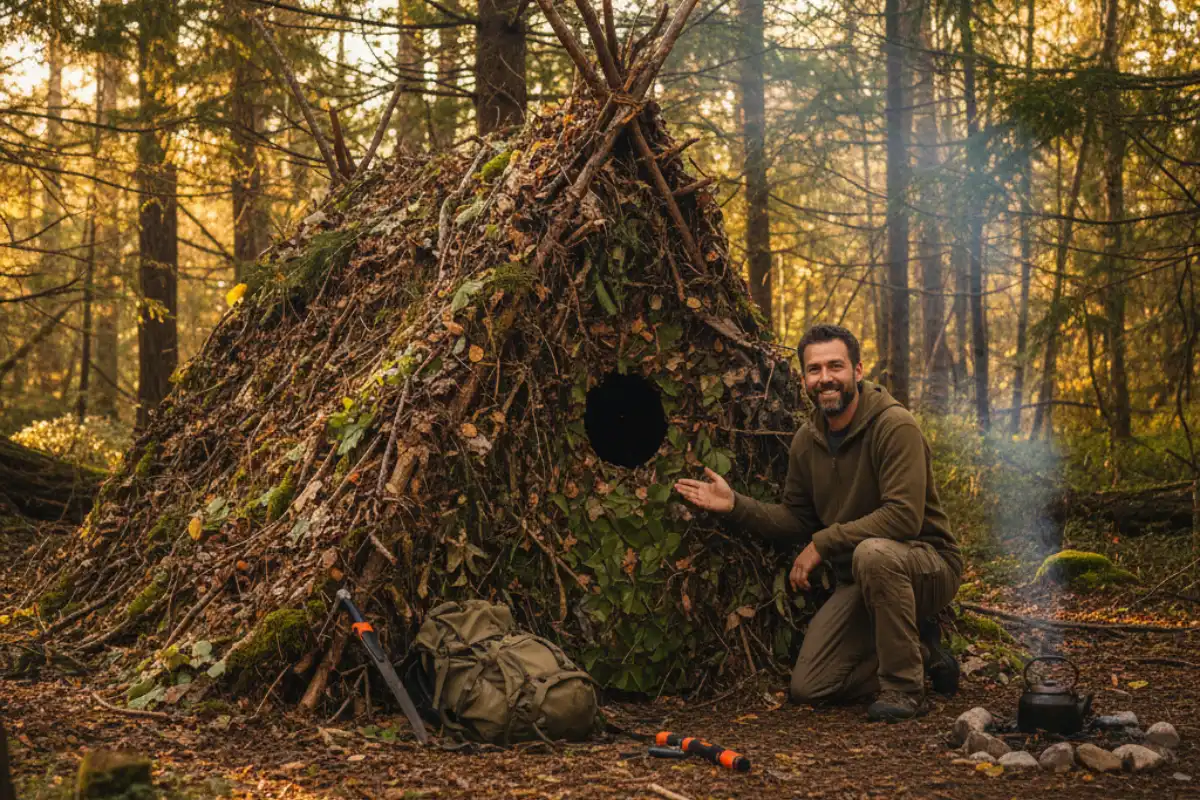
2. The Life-Saving Debris Hut (Insulation is Key)
The gold standard for cold-weather survival, designed for maximum insulation and heat retention:
- **A-Frame:** Construct a sturdy A-frame using a long ridgepole resting on a short vertical tripod or leaning against a log/tree.
- **Weaving:** Lean strong ribs against the ridgepole, forming a basket-like frame. The entrance should be small, just big enough to crawl through.
- **Insulation:** Pile an enormous amount of **fine, dry debris** (leaves, pine needles) over the entire structure. The debris layer must be at least **3 feet thick** all around, including the sides and entrance. You are essentially building a natural sleeping bag.
Field Guide Tip: Dr. Alice P., Outdoor Survival Journal
“Always practice the **’Two-Hand Test’** for your debris hut insulation. Once the debris is piled on, push your arm into the pile. If you can still feel the structural poles underneath, the layer is too thin. The goal is to create a dead-air space within the debris that prevents the transfer of heat, keeping your body’s warmth trapped inside.”
Frequently Asked Questions About Shelter Building
What is the most critical factor for a good survival shelter?
The most critical factor is **insulation**, specifically the insulation between your body and the ground (conduction) and the insulation of the roof/walls (convection). A thick layer of debris on the floor and walls is much more important than a perfectly built frame.
How small should my emergency shelter be?
A survival shelter should be **no bigger than necessary**. The smaller the interior volume, the easier it is for your body heat to warm the space. It should be just large enough for you to lie down comfortably and enter/exit safely. Excess space wastes valuable body heat.
Should I build my shelter near a water source?
Be **near** a water source, but not **in** a flood zone (like a dry creek bed) or right on the bank. Always camp at least 200 feet away from water to minimize impact on wildlife and to avoid the damp, colder air near the water’s edge, which can increase heat loss.
What materials should I avoid using for shelter building?
Avoid using dead, easily breakable wood for structural supports. Most importantly, **avoid damp materials** for insulation and bedding, as moisture conducts heat away from your body quickly. If you must use damp materials, dry them near a fire first.
What if I only have a small space blanket (Mylar) with me?
A space blanket should be used to **reflect your body heat**. Do not wrap it directly around you, as sweat will cause condensation. Use it as the inner lining of a Lean-To or Debris Hut, draped over the frame before the outer insulation, or as a radiant barrier behind your fire to direct heat towards your body.
Conclusion: Shelter First, Fire Second
In any wilderness emergency, the universal priority is to secure shelter immediately. Your ability to survive hinges on maintaining a stable core body temperature. By applying the principles of site selection (L.I.N.E.) and construction (maximizing insulation, minimizing volume), you can quickly build a highly effective shelter from a simple Lean-To for rain protection to a life-saving Debris Hut for extreme cold. These fundamental skills are your best defense against the elements, turning a precarious situation into a manageable survival scenario.